
 Redakshon
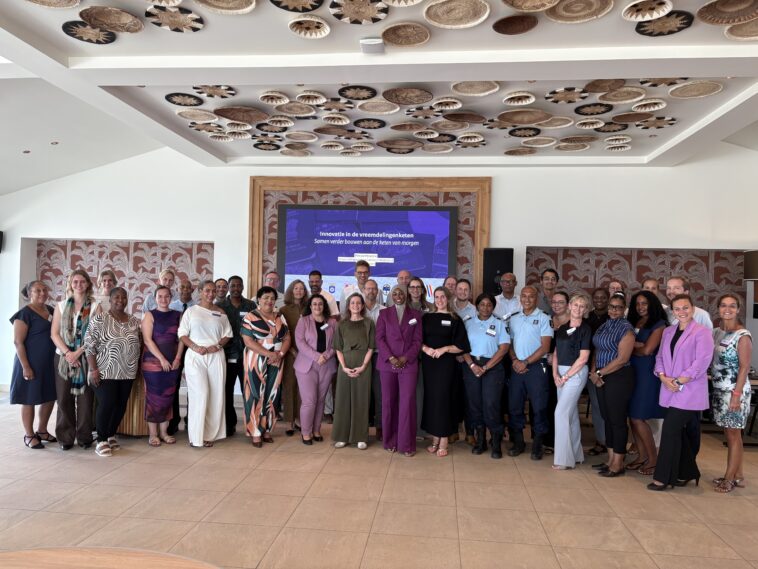
Kralendijk,- Kon e kadena di imigrashon por traha huntu mas mihó, traha mas inteligente i hasi uzo responsabel di teknologia nobo?
E preguntanan ei a okupá un lugá sentral awe, durante e Minikonferensia anual Kadena di Imigrashon Hulanda Karibense na Boneiru. Representantenan di e organisashonnan embolbí a reflehá riba desaroyo di e kadena, a diskutí e kolaborashon aktual i a eksplorá posibilidatnan pa sigui fortifiká ehekushon di tareanan konhuntamente.
E minikonferensia a konsentrá riba wak padilanti, ku atenshon pa pasado, pa medio di para ketu na komienso di e kadena di imigrashon na Hulanda Karibense na 10-10-10.

Ademas tabatin atenshon pa maneranan nobo di kolaborá, posibel uzo di partidonan eksterno i e oportunidatnan ku desaroyonan teknológiko ta ofresé pa práktika diario di e kadena di imigrashon. Di historia komun pa un kadena orientá riba futuro Durante e enkuentro a reflehá riba desaroyo di e kadena di imigrashon na Hulanda Karibense, entre otro a base di e tema
‘Huntu na kaminda’ di e minikonferensia di 2025. Tambe a trata progreso di e akshonnan ku a formulá durante enkuentronan anterior. Ku presentashon di ‘Di 10-10-10 pa mañan’ e partisipantenan a tira un bista riba desaroyo di e kadena desde 10 di òktober 2010, e situashon aktual i e retonan pa futuro. Kontribushonnan di entre otro Jonathan Johnson, eks gezaghèber di Saba, Ofisina Sentral di Estadístika i ministerio di Hustisia i Siguridat, a brinda puntonan di referensia pa sigui eksplorá e retonan komun.
Inovashon komo oportunidat pa ehekushon Inovashon tambe a haña atenshon speshal. Oradornan invitá di Servisio di Imigrashon i Naturalisashon (IND) i di e programa SBIR, a trata desaroyonan relashoná ku inteligensia artifisial (AI) i e aplikabilidat di e funshonnan di chat den prosesonan laboral.
E partisipantenan a diskutí ademas e posibilidat pa apliká teknologianan nobo, manera AI, drone, algoritmo i identifikashon biométriko. E pregunta sentral tabata, kon e desaroyonan akí por kontribuí na prosesonan laboral mas efektivo i un mihó ehekushon di e tareanan komun. Kolaborá mas leu ku frontera di e organisashonnan Den seshonnan interaktivo den grupo e partisipantenan a dialogá ku otro riba tres tema: maneranan nobo di traha i aliansanan integral, uzo di partidonan eksterno partikular i aplikashon di teknologianan nobo.
Asina a eksplorá kon interkambio di informashon mas intensivo i otro formanan di kolaborashon por fortifiká e kadena. Tambe e partisipantenan a diskutí posibilidatnan pa embolbí organisashonnan eksterno, manera organisashonnan sosial òf dunadónan di servisio 3 partikular, den e prosesonan di trabou spesífiko.
E seshonnan a brinda espasio pa interkambiá eksperensia, eksplorá oportunidatnan i formulá ideanan pa sigui desaroyá mas e kolaborashon na Hulanda Karibense. Sigui konstruí huntu E miniconferensia a enfatisá importansia di un bista komun riba futuro.
E retonan den e kadena di imigrashon ta rekerí bon sinkronisashon, kolaborashon kla i disponibilidat pa investigá posibilidatnan nobo. A klousurá e dia ku un reflekshon komun riba e resultadonan di e enkuentro.
E minikonferensia anual ta pèrkurá pa e organisashonnan embolbí keda traha riba un kadena di imigrashon, den kua kolaborashon, interkambio di konosementu i inovashon, ta kontribuí na ehekushon efektivo di e tareanan komun na Hulanda Karibense.
E aña akí Servisio di Regreso i Salida, Koninklijke Marechaussee, IND CN i direktorado Maneho di imigrashon di Ministerio di Hustisia i Siguridat a organisá e konferensia na Boneiru.
FUENTE: RCN/LIVE99FM
NEDERLAND:
VREEMDELINGENKETEN CARIBISCH NEDERLAND KIJKT VOORUIT: MEER SAMENWERKING EN INNOVATIE CENTRAAL TIJDENS MINICONFERENTIE OP BONAIRE
Kralendijk,- oe kan de vreemdelingenketen in Caribisch Nederland beter samenwerken, slimmer werken en nieuwe technologie verantwoord inzetten? Die vragen stonden vandaag centraal tijdens de jaarlijkse Miniconferentie Vreemdelingenketen Caribisch Nederland op Bonaire.
Vertegenwoordigers van de betrokken organisaties blikten terug op de ontwikkeling van de keten, bespraken de huidige samenwerking en verkenden mogelijkheden om de gezamenlijke uitvoering van taken verder te versterken.
Directeur generaal Migratieketen Esther Pijs en de gezaghebber John Soliano waren tevens aanwezig als sprekers. De miniconferentie stond in het teken van vooruitkijken met aandacht voor het verleden door stil te staan bij de start van de vreemdelingenketen op Caribisch Nederland in 10-10 10. Daarbij was aandacht voor nieuwe manieren van samenwerken, de mogelijke inzet van externe partijen en de kansen die technologische ontwikkelingen bieden voor de dagelijkse praktijk van de vreemdelingenketen.
Van gezamenlijke geschiedenis naar een toekomstgerichte keten Tijdens de bijeenkomst werd teruggeblikt op de ontwikkeling van de vreemdelingenketen in Caribisch Nederland, onder meer aan de hand van het thema ‘Samen onderweg’ uit de miniconferentie van 2025.
Ook kwam de voortgang aan bod van de acties die tijdens eerdere bijeenkomsten zijn geformuleerd. Met de presentatie ‘Van 10-10-10 naar morgen’ keken de deelnemers naar de ontwikkeling van de keten sinds 10 oktober 2010, de huidige stand van zaken en de opgaven voor de toekomst. Bijdragen van onder meer Jonathan Johnson, de voormalig gezaghebber van Saba, het Centraal Bureau voor de Statistiek en het ministerie van Justitie en Veiligheid boden aanknopingspunten om de gezamenlijke uitdagingen verder te verkennen. Innovatie als kans voor de uitvoering Ook innovatie kreeg nadrukkelijk aandacht.
Gastsprekers van de Immigratie- en Naturalisatiedienst (IND) en het SBIR-programma gingen in op ontwikkelingen rond kunstmatige intelligentie (AI) en chatfunctionaliteiten in werkprocessen. De deelnemers bespraken daarnaast de mogelijke toepassing van nieuwe technologieën, zoals AI, drones, algoritmes en biometrische identificatie.
De centrale vraag was hoe deze ontwikkelingen kunnen bijdragen aan effectievere werkprocessen en een betere uitvoering van de gezamenlijke taken. Samenwerken over organisatiegrenzen heen In interactieve break-outsessies gingen de deelnemers met elkaar in gesprek over drie thema’s: nieuwe manieren van werken en integrale samenwerkingsverbanden, de inzet van externe private partijen en de toepassing van nieuwe technologieën.
1 Zo werd verkend hoe intensievere informatie-uitwisseling en andere samenwerkingsvormen de keten kunnen versterken. Ook bespraken de deelnemers mogelijkheden om externe organisaties, zoals maatschappelijke organisaties of particuliere dienstverleners, bij specifieke werkprocessen te betrekken.
De sessies boden ruimte om ervaringen uit te wisselen, kansen te onderzoeken en ideeën te formuleren voor de verdere ontwikkeling van de samenwerking in Caribisch Nederland. Samen verder bouwen De miniconferentie benadrukte het belang van een gezamenlijke blik op de toekomst. De uitdagingen binnen de vreemdelingenketen vragen om goede afstemming, heldere samenwerking en de bereidheid om nieuwe mogelijkheden te onderzoeken.
De dag werd afgesloten met een gezamenlijke terugblik op de opbrengsten van de bijeenkomst. Met de jaarlijkse miniconferentie blijven de betrokken organisaties werken aan een vreemdelingenketen waarin samenwerking, kennisdeling en innovatie bijdragen aan een effectieve uitvoering van de gezamenlijke opgaven in Caribisch Nederland.
Dit jaar werd de conferentie georganiseerd op Bonaire door Dienst Terugkeer en Vertrek, Koninklijke Marechaussee, IND CN en directie Migratiebeleid van het Ministerie van Justitie en Veiligheid.
ENGELS:
CARIBBEAN NETHERLANDS IMMIGRATION CHAIN LOOKS AHEAD: INCREASED COOPERATION AND INNOVATION TAKE CENTRE STAGE AT MINI CONFERENCE ON BONAIRE
Kralendijk,- How can the immigration chain in the Caribbean Netherlands cooperate better, work smarter and deploy new technology responsibly? Those questions were the focus today of the annual Caribbean Netherlands immigration chain mini conference on Bonaire.
Representatives of the organisations involved looked back on the development of the chain, discussed the current cooperation and explored opportunities to further strengthen the joint performance of tasks. Director-General of the Migration Chain Esther Pijs and Island Governor John Soliano were also present as speakers.
The mini conference was devoted to looking ahead with attention to the past, by reflecting on the launch of the immigration chain in the Caribbean Netherlands on 10-10-10. In this context, attention was given to new ways of cooperating, the possible deployment of external parties and the opportunities that technological developments offer for the day-to-day practice of the immigration chain.
From a shared history to a future-oriented chain During the meeting, the development of the immigration chain in the Caribbean Netherlands was reviewed, including with reference to the theme ‘Moving Forward Together’ from the 2025 mini conference.
The progress of the actions formulated during previous meetings was also discussed. With the presentation ‘From 10-10-10 to Tomorrow’, the participants looked at the development of the chain since 10 October 2010, the current state of affairs and the challenges for the future.
Contributions from, among others, Jonathan Johnson, the former Island Governor of Saba, Statistics Netherlands and the Ministry of Justice and Security provided starting points for further exploring the shared challenges. Innovation as an opportunity for implementation Innovation also received particular attention.
Guest speakers from the Immigration and Naturalisation Service (IND) and the SBIR Programme addressed developments concerning artificial intelligence (AI) and chat functionalities in work processes. The participants also discussed the possible application of new technologies, such as AI, drones, algorithms and biometric identification.
The central question was how these developments can contribute to more effective work processes and better performance of the joint tasks. Cooperating across organisational boundaries In interactive breakout sessions, the participants held discussions with one another on three themes: new ways of working and integrated partnerships, the deployment of external private parties, and the application of new technologies.
5 In this way, it was explored how more intensive exchange of information and other forms of cooperation can strengthen the chain. The participants also discussed opportunities to involve external organisations, such as civil-society organisations or private service providers, in specific work processes.
The sessions provided scope to exchange experiences, explore opportunities and formulate ideas for the further development of cooperation in the Caribbean Netherlands. Continuing to build together The mini conference emphasised the importance of a shared view of the future.
The challenges within the immigration chain call for good coordination, clear cooperation and a willingness to explore new possibilities. The day concluded with a joint review of the outcomes of the meeting.
Through the annual mini conference, the organisations involved continue to work towards an aliens chain in which cooperation, knowledge sharing and innovation contribute to the effective performance of the joint tasks in the Caribbean Netherlands.
This year, the conference was organised on Bonaire by the Repatriation and Departure Service, the Royal Netherlands Marechaussee, IND CN and the Migration Policy Department of the Ministry of Justice and Security.




GIPHY App Key not set. Please check settings